
Dating & Relationships
Attachment Styles in Relationships: Complete Guide to Secure, Anxious, Avoidant & Disorganized Types


Introduction to Attachment Styles
Attachment styles serve as the foundation for how we interact in our relationships. Developed in childhood and often cemented by our early interactions, these styles can dictate the level of emotional intimacy we tolerate, how we handle fear of abandonment, and our capacity for trust and dependence on others.
Through a deep dive into secure attachment, anxious attachment, avoidant attachment, and disorganized attachment, this guide aims to shed light on the pivotal role these patterns play. It offers a route towards self-awareness, advocating for strategies to transition towards secure attachment. By understanding these dynamic styles, you embark on a path of personal development, ultimately fostering healthier and more fulfilling connections.
Key Takeaways:
- Navigating Attachment Styles: Recognizing and understanding your attachment style is crucial for personal growth and improving interpersonal relationships.
- From Awareness to Action: Identifying traits of different attachment styles enables individuals to work towards secure attachment through self-awareness and professional guidance.
- Enhancing Relationship Dynamics: Understanding attachment styles offers insights into managing interpersonal conflicts and fostering emotional health within connections.
The Evolution of Attachment Theory
Attachment theory, initially developed by British psychologist John Bowlby in the 1950s and 1960s, has evolved significantly since its inception. Bowlby posited that children have an innate need to form close emotional bonds with caregivers, a foundation that shapes future interpersonal relationships.
Later, developmental psychologist Mary Ainsworth expanded on his work through the famous “Strange Situation” study in the 1970s, which classified attachment into secure, anxious, and avoidant styles. This framework laid the groundwork for understanding the complex dynamics of adult relationships.
In 1986, researchers Mary Main and Judith Solomon identified a fourth style—disorganized attachment—further enriching the discourse on emotional intimacy and dependence. According to research, approximately 50-60% of the population has a secure attachment style, while 20% show anxious patterns, 15-25% demonstrate avoidant tendencies, and about 5-10% exhibit disorganized attachment.
Today, the work of Mario Mikulincer and Phillip Shaver has been pivotal in applying attachment theory to adult relationship patterns. They stress the importance of recognizing and addressing attachment-related issues for personal development and healthier connections. This ongoing exploration underscores that early childhood experiences heavily influence one’s approach to trust, fear of abandonment, and interpersonal conflicts throughout life.
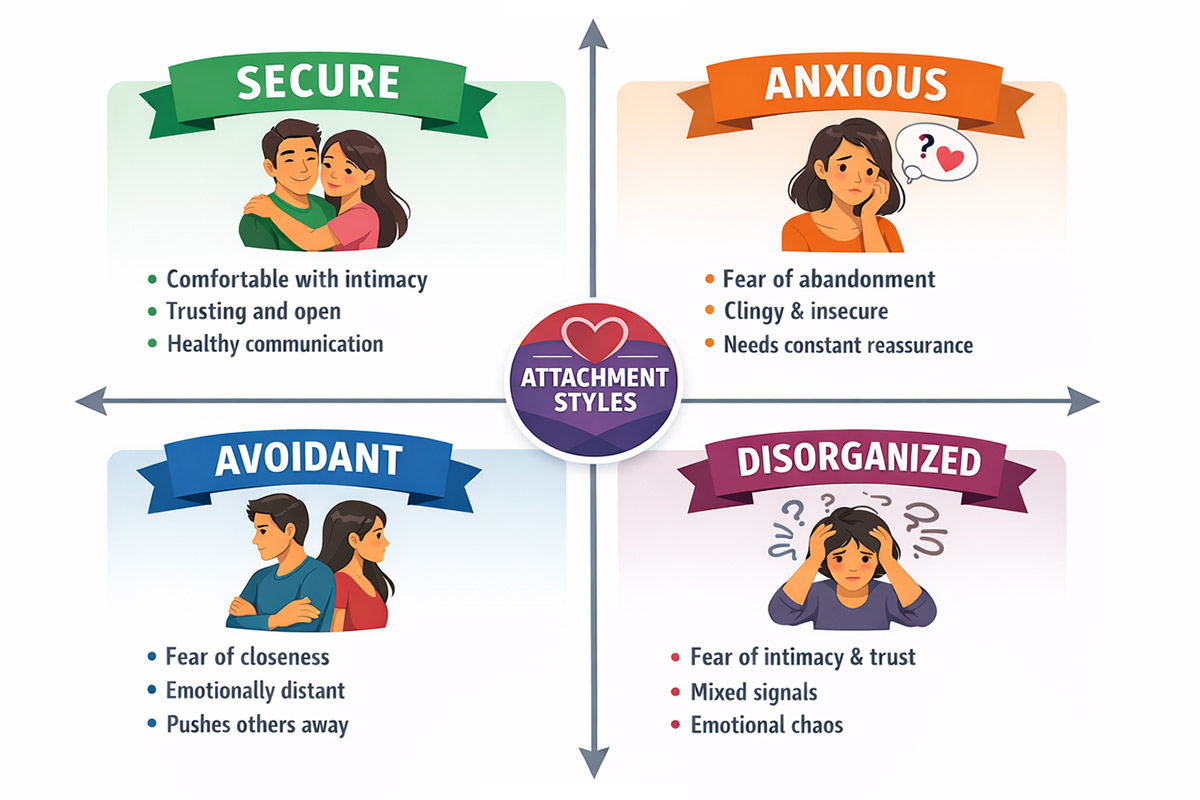
Understanding the Four Main Attachment Styles
Delving into the realm of attachment styles unveils four distinct types that fundamentally shape our connections with others.
1. Secure Attachment: The Foundation of Healthy Relationships
Secure attachment empowers people to build trust naturally, fostering emotional intimacy with ease. Individuals here enjoy healthy dependencies without fearing abandonment.
Key characteristics include:
- Comfortable with both intimacy and independence
- Able to communicate needs directly
- Trust others without excessive worry
- Handle conflicts constructively
- Maintain strong self-esteem in relationships
- Show empathy and emotional availability
In relationships: Securely attached individuals create stable, long-lasting partnerships. They view relationship challenges as opportunities for growth rather than threats. Studies show that relationships where at least one partner has secure attachment have significantly higher satisfaction rates and lower divorce rates.
2. Anxious Attachment: The Constant Seeker
Anxious attachment heralds a constant quest for reassurance, stemming from deep-seated fears of being left alone. This style often struggles with self-awareness and might find it difficult to manage interpersonal conflicts without external support.
Key characteristics include:
- Intense fear of abandonment
- Craving constant reassurance
- Heightened sensitivity to partner’s moods
- Tendency to become preoccupied with relationships
- Difficulty trusting partner’s commitment
- May appear “clingy” or demanding
In relationships: Those with anxious attachment often experience relationship anxiety and may inadvertently push partners away through their intense need for closeness. They interpret minor setbacks as dire threats to the relationship. Research indicates that about 20% of adults display anxious attachment patterns.
3. Avoidant Attachment: The Independent Distancer
Avoidant attachment profiles those who distance themselves from emotional closeness, viewing self-reliance as paramount. Personal development for them might mean learning to tolerate intimacy.
Key characteristics include:
- Strong emphasis on independence
- Discomfort with emotional vulnerability
- Tendency to suppress feelings
- Difficulty depending on others
- May seem emotionally distant or cold
- Values personal space above connection
In relationships: Avoidantly attached individuals often struggle to open up emotionally. They may withdraw during conflicts or when their partner seeks more intimacy. This pattern affects 15-25% of the population and often stems from childhood experiences where emotional needs were consistently dismissed.
4. Disorganized Attachment: The Fearful Combination
Disorganized attachment exhibits a chaotic mix of behaviors, indicative of unresolved childhood development issues. People with this style grapple with emotional expression and dependence. Sometimes called “fearful-avoidant,” this represents the most challenging attachment pattern.
Key characteristics include:
- Contradictory relationship behaviors
- Both craving and fearing intimacy
- Unpredictable emotional responses
- Difficulty regulating emotions
- May display both anxious and avoidant traits
- Often stems from childhood trauma or abuse
In relationships: Individuals oscillate between seeking closeness and pushing others away, reflecting their inner battle between the desire for intimacy and the fear of it. This pattern affects approximately 5-10% of adults and often requires professional intervention to address effectively.
How to Identify Your Attachment Style
Understanding your attachment style is the first step toward building healthier relationships. Here’s how to recognize your pattern:
Self-Assessment Questions
Ask yourself these key questions:
About intimacy:
- How comfortable am I with emotional closeness?
- Do I often worry about being abandoned?
- Do I prefer to keep partners at arm’s length?
- Am I comfortable depending on others?
About conflict:
- How do I typically respond when my partner is upset?
- Do I withdraw or pursue during disagreements?
- Can I express my needs clearly without anxiety?
About trust:
- How easily do I trust new partners?
- Do I constantly worry about my partner’s feelings for me?
- Do I believe people will ultimately let me down?
Common Patterns by Type
Secure: You feel comfortable both giving and receiving love. You can be vulnerable without excessive fear.
Anxious: You constantly check your phone for messages. You need frequent reassurance that your partner still cares.
Avoidant: You feel suffocated when partners want to get “too close.” You value independence above all else.
Disorganized: Your behavior confuses even you—one day you’re intensely connected, the next you’re completely withdrawn.
Important Note
Most people don’t fit exactly into one category. You might display different attachment styles in different relationships or situations. The goal isn’t perfection—it’s awareness and growth.
The Spectrum of Attachment
Understanding attachment styles unveils the complexity of human interactions. It illuminates why a one-size-fits-all approach cannot apply to emotional connections. Indeed, these styles emerge as a spectrum, highlighting the diverse ways individuals engage in relationships.
People rarely embody a single category with absolute precision. Instead, traits from secure, anxious, avoidant, and disorganized attachment often intermingle within one’s behavior. This blend reflects a person’s unique history of emotional intimacy, trust issues, and fear of abandonment.
Witnessing someone navigate through the nuances of their attachment pattern offers a glimpse into their childhood development and emotional expression. It lays bare the impact of early experiences on dependence and interpersonal dynamics.
Consequently, realizing this spectrum empowers individuals to embark on a journey involving self-awareness and personal development. It motivates the quest for strategies aiming at intimacy tolerance and becoming more securely attached, despite the shadows of past conflicts. Understanding this variety can significantly foster healthier relationship dynamics, marked by improved trust and emotional resilience.
How Childhood Shapes Attachment
Early life experiences and interactions with caretakers fundamentally set the stage for an individual’s attachment style, laying down a blueprint for future relationships. These crucial early interactions demonstrate to a child what to expect from intimate connections.
The Formation Process
Secure attachment develops when:
- Caregivers consistently respond to a child’s needs
- Emotional support is readily available
- The child feels safe exploring the world
- Distress is met with comfort and reassurance
Anxious attachment forms when:
- Caregiver responses are inconsistent or unpredictable
- Sometimes attentive, sometimes dismissive
- The child never knows what to expect
- Emotional needs are met erratically
Avoidant attachment emerges when:
- Caregivers are emotionally unavailable or dismissive
- Independence is overly emphasized
- Emotional expression is discouraged
- The child learns self-reliance as survival
Disorganized attachment results from:
- Traumatic experiences or abuse
- Caregiver who is both source of comfort and fear
- Severely neglectful or chaotic home environment
- Unresolved trauma in the caregiver
The Good News
Childhood development plays a pivotal role in how individuals navigate dependence and express themselves emotionally within relationships. However, these patterns are not permanent. Acknowledging the impact of childhood on attachment styles can be a critical step in personal development, guiding one towards self-awareness and the pursuit of psychological help if needed.
Research by Mikulincer and Shaver demonstrates that attachment styles can change through:
- Corrective relationship experiences
- Therapy and professional intervention
- Conscious self-work and awareness
- Secure relationships in adulthood
Attachment Styles in Dating and Relationships
The Anxious-Avoidant Trap
One of the most common—and challenging—relationship dynamics occurs when anxious and avoidant attachment styles come together. This creates what psychologists call the “anxious-avoidant relationship trap”:
The cycle:
- Anxious partner seeks closeness and reassurance
- Avoidant partner feels suffocated and withdraws
- Anxious partner panics and pursues harder
- Avoidant partner distances further
- The cycle intensifies
Why it happens: Each person’s behavior triggers the other’s core fear. The anxious person’s pursuit confirms the avoidant person’s belief that intimacy is overwhelming. The avoidant person’s withdrawal confirms the anxious person’s fear of abandonment.
Breaking the pattern:
- Both partners must recognize the cycle
- The anxious partner practices self-soothing
- The avoidant partner works on staying present
- Both commit to communicating needs clearly
- Professional guidance is often beneficial
Secure-Secure Pairings
When two securely attached individuals partner, relationships tend to be:
- Stable and satisfying
- Lower in conflict
- Better at problem-solving
- More emotionally resilient
- Characterized by mutual support
Mixed Pairings
Secure + Anxious: The secure partner can provide the stability and reassurance the anxious partner needs, often helping them move toward more secure attachment.
Secure + Avoidant: The secure partner’s patience and understanding can help the avoidant partner gradually become more comfortable with intimacy.
Anxious + Anxious: Both partners may struggle with reassurance-seeking, but they often understand each other’s needs for closeness.
Avoidant + Avoidant: While both value independence, they may struggle to build deep emotional intimacy.
Attachment Styles in Relationship Conflicts
Attachment styles deeply influence interpersonal dynamics, particularly during conflicts.
Secure Attachment in Conflict
Those with secure attachment often face disputes with confidence, navigating conflicts with a blend of empathy and firmness. They rely on direct communication and emotional honesty to find common ground. Trust issues rarely cloud judgment, allowing secure individuals to foster understanding and resolution.
Conflict strategies:
- Address issues directly but kindly
- Listen actively to partner’s perspective
- Seek compromise and mutual understanding
- Can take breaks without abandoning the conversation
- Focus on solving problems, not winning arguments
Anxious Attachment in Conflict
Anxious attachment leads individuals to perceive conflicts as catastrophic threats to relationship stability. Haunted by a fear of abandonment, they might escalate disputes or seek reassurance compulsively. This pattern complicates resolutions, making it hard for partners to address actual issues without triggering further insecurities.
Conflict patterns:
- May become emotionally reactive quickly
- Difficulty staying calm during disagreements
- Interpret criticism as rejection
- May pursue partner who tries to take space
- Need frequent reassurance during and after conflicts
Avoidant Attachment in Conflict
Those leaning towards avoidant attachment adopt a radically different stance. For them, emotional intimacy signals danger, prompting withdrawal into silence or dismissiveness during conflicts. This evasive strategy might temporarily deflate tension but often leaves root problems unaddressed, breeding resentment and distance.
Conflict behaviors:
- Shut down or stonewall
- Minimize partner’s concerns
- Prefer to “just move on” without resolution
- May physically leave during heated moments
- Struggle to articulate feelings and needs
Disorganized Attachment in Conflict
In the realm of disorganized attachment, predictability fades. Here, individuals swing between anxious and avoidant strategies, bewildering their partners. Trapped in a cycle of trust issues and fear, finding a path to resolution can feel like navigating a labyrinth without a map.
Conflict characteristics:
- Unpredictable emotional responses
- May become aggressive or completely withdrawn
- Difficulty regulating intense emotions
- Past trauma may be triggered
- Often requires professional support to navigate

Paths to Secure Attachment
The journey toward secure attachment begins with recognizing your patterns. Here are proven strategies for developing more secure attachment:
The Role of Self-Awareness
Acknowledging personal attachment styles emerges as a pivotal stride in the journey of self-improvement and cultivating robust, healthier connections. This process demands a profound degree of self-awareness.
Steps to build self-awareness:
- Reflect on your relationship patterns
- What behaviors repeat across relationships?
- What triggers your insecurity or withdrawal?
- How did you see relationships modeled growing up?
- Journal your emotional responses
- Track your reactions to intimacy and distance
- Notice patterns in your thoughts and behaviors
- Identify your core fears and needs
- Seek feedback from trusted friends
- Ask how they experience you in relationships
- Listen without becoming defensive
- Consider patterns across multiple perspectives
- Practice mindfulness
- Observe your attachment patterns without judgment
- Notice when you’re reacting from fear vs. responding consciously
- Create space between trigger and response
Mastery over one’s attachment dynamics can be transformative, offering a path to overcoming hurdles like interpersonal conflicts and the quest for psychological help. It sets the stage for evolution towards secure attachment.
Seeking Professional Guidance
Seeking the assistance of a mental health professional marks a pivotal step in navigating attachment challenges. With expertise in attachment styles, these professionals can offer invaluable guidance, paving the way for understanding and growth.
Types of therapeutic approaches:
Emotionally Focused Therapy (EFT): Specifically designed to address attachment issues in relationships. EFT helps couples understand their attachment patterns and create more secure bonds.
Psychodynamic Therapy: Explores how early childhood experiences shape current relationship patterns, providing insight into the roots of attachment issues.
Cognitive Behavioral Therapy (CBT): Helps identify and change negative thought patterns and behaviors associated with insecure attachment.
Schema Therapy: Addresses deep-rooted patterns and unmet childhood needs that contribute to attachment difficulties.
Engaging with a therapist or counselor can opens doors to untangling the web of fear of abandonment and dependence struggles that many face. Sessions focused on personal development and intimacy tolerance strategies foster the ability to form healthier, more fulfilling relationships.
Research by Mikulincer and Shaver underscores the transformative potential of psychological help in achieving attachment security. Furthermore, professionals provide tools for managing interpersonal conflicts more effectively, allowing individuals to navigate relational waters with newfound confidence.
Practical Strategies for Each Attachment Style
For Anxious Attachment:
Practice self-soothing:
- Develop techniques to calm yourself without partner’s reassurance
- Build activities and relationships outside the romantic partnership
- Challenge catastrophic thinking patterns
- Use mindfulness to manage relationship anxiety
Build secure base:
- Work with a therapist to process abandonment fears
- Practice expressing needs without desperation
- Learn to tolerate normal relationship space
- Develop stronger sense of self-worth independent of relationship
For Avoidant Attachment:
Increase emotional awareness:
- Practice identifying and naming feelings
- Challenge beliefs that vulnerability equals weakness
- Gradually increase emotional sharing with safe people
- Notice when you’re withdrawing and choose to stay present
Build intimacy tolerance:
- Start with small acts of vulnerability
- Practice accepting care and support from others
- Work on expressing needs and allowing dependence
- Challenge beliefs about independence and self-sufficiency
For Disorganized Attachment:
Trauma-informed therapy:
- Work with professionals trained in trauma
- Process past experiences that created disorganized patterns
- Learn emotional regulation skills
- Build consistent, safe relationships gradually
Develop stability:
- Create predictable routines and structures
- Practice grounding techniques for emotional overwhelm
- Build trust slowly with consistent, safe people
- Be patient with yourself—healing takes time
Building Secure Relationships
Regardless of your starting attachment style, you can work toward more secure patterns:
Communication practices:
- Express needs clearly and directly
- Listen without defensiveness
- Practice “I” statements during conflicts
- Schedule regular relationship check-ins
Boundary setting:
- Identify and communicate your needs
- Respect partner’s boundaries
- Balance togetherness and independence
- Say no without guilt or explanation
Trust building:
- Follow through on commitments consistently
- Be reliable and predictable
- Share vulnerabilities gradually
- Respond to partner’s bids for connection
Emotional regulation:
- Develop healthy coping mechanisms
- Practice self-care consistently
- Take responsibility for your emotions
- Avoid blame and criticism
Common Myths About Attachment Styles
Myth 1: “Your attachment style is permanent”
Reality: While attachment styles are stable, they can change. Research shows that significant relationships, therapy, and conscious self-work can shift attachment patterns toward security.
Myth 2: “Only people with secure attachment can have healthy relationships”
Reality: People with insecure attachment can absolutely have healthy relationships. Awareness, effort, and often professional support can help manage attachment challenges effectively.
Myth 3: “Attachment styles only affect romantic relationships”
Reality: Attachment styles influence all close relationships—friendships, family bonds, and even professional relationships. The patterns show up wherever intimacy and trust are involved.
Myth 4: “If you have insecure attachment, you’re damaged”
Reality: Insecure attachment is an adaptation to your early environment, not a character flaw. It’s your psyche’s way of protecting you based on past experiences. With awareness and work, these patterns can shift.
Myth 5: “Anxious and avoidant people should never date each other”
Reality: While this pairing presents challenges, with awareness and commitment from both partners, these relationships can work. Both partners must be willing to understand their patterns and work on them.
Frequently Asked Questions About Attachment Styles
Can attachment styles change over time?
Yes, attachment styles can change. Research indicates that significant life experiences, therapy, and secure relationships can help shift attachment patterns. Studies show that about 20-30% of people experience changes in their attachment style over their lifetime. The most common shift is toward security through corrective relationship experiences.
How do I know if I need therapy for my attachment issues?
Consider therapy if your attachment patterns are:
- Causing repeated relationship problems
- Leading to significant distress or anxiety
- Preventing you from forming close relationships
- Rooted in trauma or abuse
- Not improving despite self-help efforts
Even if your issues seem manageable, therapy can accelerate growth and provide valuable insights.
What if my partner and I have incompatible attachment styles?
Incompatible attachment styles don’t doom a relationship. The key is awareness and communication. Many couples with different attachment styles build successful relationships by:
- Understanding each other’s patterns and triggers
- Communicating needs clearly
- Working together on compromise strategies
- Seeking couples therapy when needed
- Both partners committing to personal growth
How long does it take to develop secure attachment?
There’s no fixed timeline. Developing secure attachment depends on:
- Your starting attachment pattern
- Consistency of effort and self-work
- Quality of current relationships
- Whether you’re in therapy
- Severity of early attachment wounds
Some people notice shifts within months; for others, it may take years of consistent work. Progress isn’t always linear, but every step forward counts.
Can you have different attachment styles in different relationships?
Yes, you can display different attachment styles in different contexts. You might be secure with friends but anxious in romantic relationships, or secure in romantic partnerships but avoidant with family. However, most people have a dominant attachment pattern that shows up across most close relationships.
Are some attachment styles more common in men vs. women?
Research shows minimal gender differences in overall attachment style distribution. However, cultural conditioning may influence how attachment patterns manifest:
- Men may be socialized to express avoidant patterns more openly
- Women may be more comfortable acknowledging anxious tendencies
- Both genders experience all attachment styles in similar proportions
The expression may differ, but the underlying patterns are universal.
Can children develop secure attachment even if their parents were insecure?
Absolutely. While parental attachment patterns influence children, they don’t determine destiny. Children can develop secure attachment if:
- At least one caregiver is consistently responsive
- Other secure adults (grandparents, teachers) provide stability
- Parents work on their own attachment issues
- The overall caregiving environment is “good enough”
Perfection isn’t required—consistency and responsiveness matter most.
Is it possible to be too secure in your attachment?
Secure attachment isn’t about having no boundaries or never experiencing relationship anxiety. It’s about having a flexible, balanced approach to relationships. Truly secure individuals:
- Can be vulnerable but maintain boundaries
- Trust appropriately without being naive
- Experience normal relationship concerns without being consumed by them
- Balance intimacy and independence healthily
If someone seems to have no relationship concerns or boundaries, they may actually be displaying avoidant patterns rather than true security.
Resources for Further Learning
Recommended Books
“Attached” by Amir Levine and Rachel Heller – Excellent introduction to attachment theory in adult relationships with practical advice.
“Hold Me Tight” by Dr. Sue Johnson – Based on Emotionally Focused Therapy, offers exercises for couples to build secure bonds.
“The Power of Attachment” by Diane Poole Heller – Provides healing strategies for each attachment style with trauma-informed approaches.
“Wired for Love” by Stan Tatkin – Neuroscience-based approach to understanding attachment and building secure relationships.
Professional Organizations
- American Psychological Association (APA): Find licensed therapists specializing in attachment
- International Centre for Excellence in Emotionally Focused Therapy: Locate EFT-trained professionals
- Psychology Today Therapist Finder: Search for attachment-focused therapists in your area
Online Resources
- Attachment Project: Educational resources and assessment tools
- The Gottman Institute: Research-based relationship advice
- Circle of Security: Programs for parents and individuals
Conclusion: The Journey Towards Attachment Security
Delving into the heart of our connections, the journey we undertake to unravel and comprehend our attachment styles is both pivotal and transformative. It serves as the foundation for fostering relationships characterized by depth, stability, and emotional health. The path toward attachment security is not solely about achieving a secure attachment style but embracing the full spectrum of our relational dynamics.
Understanding the nuances between secure, anxious, avoidant, and disorganized attachment sheds light on the intricate dance of intimacy, trust, and emotional expression. For those grappling with fear of abandonment or wrestling with trust issues, recognizing these patterns offers a beacon of hope. It illuminates the steps needed to navigate forward, urging us towards self-awareness and personal development.
This process is not a solitary journey. Psychological help and professional guidance play crucial roles in healing attachment wounds and fostering the ability to engage in healthy, interdependent relationships. Mikulincer and Shaver’s work underscored the impact of childhood development on adult relational styles, offering insights into how early experiences with caretakers lay the groundwork for our future connections.
The implication is clear: the relational templates we formed in childhood are not static. They can evolve. By acknowledging this, we gain the power to redefine our narrative towards emotional wellness and attachment security.
Working on our attachment styles mandates a proactive stance on personal growth, including the development of strategies for managing and resolving interpersonal conflicts. Whether it involves seeking solace in therapeutic support or embracing the journey of self-discovery, each step forward brings us closer to becoming more securely attached.
This shift not only enhances our ability to tolerate emotional intimacy; it revolutionizes our approach to relationships, opening us to a world where trust, empathy, and mutual support flourish. The implications for our mental health are profound. As we journey towards attachment security, we not only transform our relationships but also our overall wellbeing.
In doing so, we become architects of our emotional destiny, capable of building connections that withstand the test of time. Understanding and working on our attachment styles is not just an act of self-improvement—it’s a testament to the resilience and capacity for change inherent within us all.
Take the Next Step
Ready to improve your relationship patterns? Start by:
- Taking time to honestly assess your attachment style
- Discussing attachment patterns with your partner
- Considering professional support if patterns are causing distress
- Committing to the journey of personal growth
Remember: awareness is the first step, but consistent action creates lasting change!



Southwest Airlines Facing Backlash After Getting Rid Of Open Seating

Samsung Galaxy S26: Smarter AI, 200MP Camera, New Privacy Display

Indian Motorcycle Drops Stunning 125th Anniversary Collection

Polaris Slingshot’s 2026 Signature Edition Is An Absolute Head-Turner

TAG Heuer’s New F1 Smartwatch Is Built For Race Fans

Netflix’s ‘War Machine’ Turns Army Ranger Training Into Fight For Survival

Tinder’s New Chemistry Feature Could End Your Swiping Nightmare

Apple CarPlay Could Soon Support ChatGPT and Other AI Assistants

Breitling Named The Official Watch Partner Of Aston Martin And F1 Team

10 Tips To Score Last-Minute Winter Travel Deals Without Sacrificing Comfort

Watch The Fast And Furious Trailer For ‘Hobbs & Shaw’

A Dance-Off For The Ages Broke Out At Monday Night’s 76ers Game

Netflix Drops ‘Black Mirror: Bandersnatch’ Trailer Ahead Of Release Tomorrow

Former NASA Engineer Gets Revenge On Package Thief With Glitter Bomb

Recent Comments