
AI
Google’s Project Suncatcher Could Move AI Data Centers Into Space

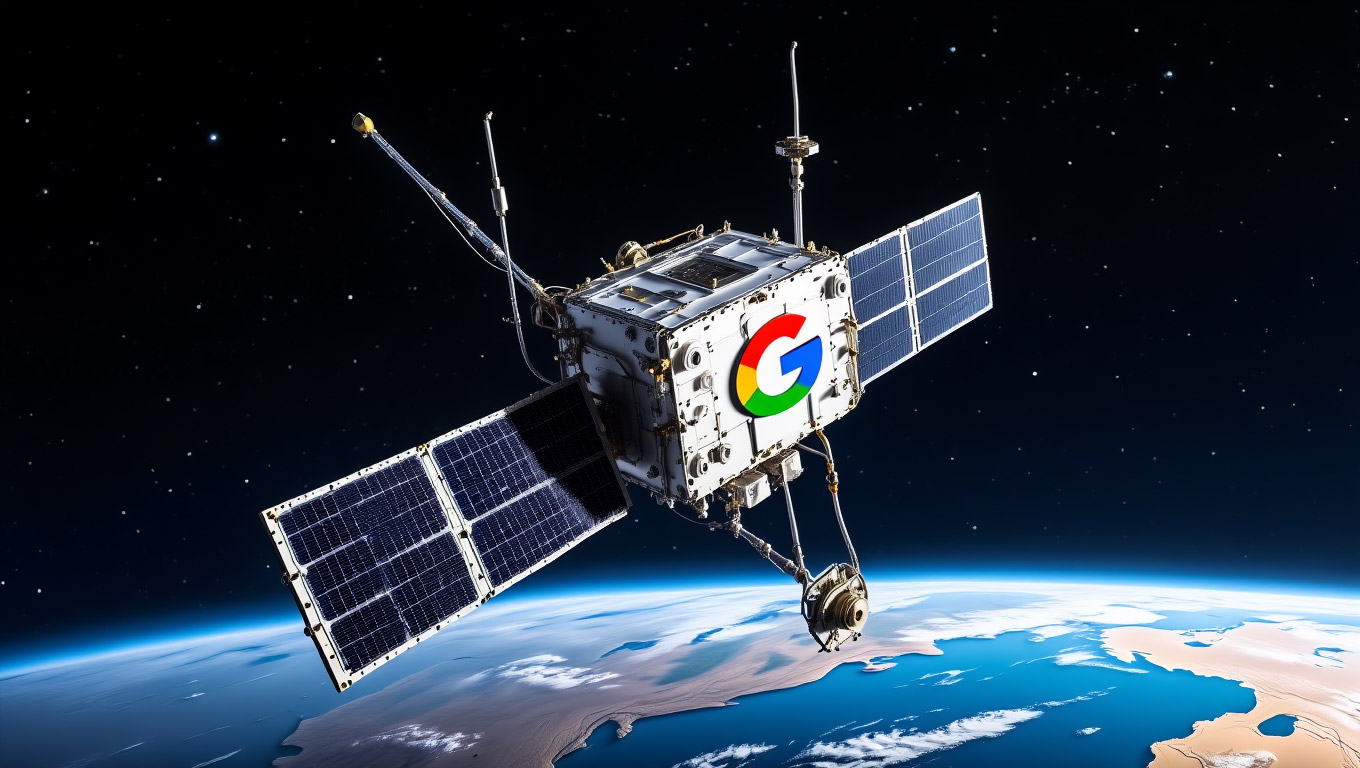
The race to power the AI revolution just went orbital. Google has unveiled Project Suncatcher, a research initiative that could fundamentally change how we think about AI infrastructure by launching solar-powered data centers into space, where they will be able to harness constant sunlight and avoid the huge power constraints that are holding back Earth-based operations.
The Space Advantage: 8X Power, Zero Downtime
Here’s the problem Google is solving: AI is hungry for power. We’re talking data centers that consume enough electricity to power small cities, and the demand is only accelerating as more people utilize AI. Google’s solution? Take the whole operation to where the sun never sets.
“The Sun is the ultimate energy source in our solar system, emitting more power than 100 trillion times humanity’s total electricity production. In the right orbit, a solar panel can be up to 8 times more productive than on earth, and produce power nearly continuously, reducing the need for batteries,” according to Google’s research announcement.
The company plans to deploy compact constellations of satellites equipped with their Tensor Processing Units (TPUs) in a dawn-dusk sun-synchronous low-earth orbit—essentially an orbital path that keeps the satellites in constant sunshine. We’re talking no night cycle, no weather interference, no need for massive battery systems. Just continuous, clean energy powering AI workloads 24/7.
Real Hardware, Real Testing
This isn’t just theoretical. Google has already put their AI chips to the test to see if they can survive the harsh reality of space. They took their Trillium v6e Cloud TPU to UC Davis and blasted it with a 67MeV proton beam to simulate years of cosmic radiation exposure.
The results were impressive. “While the High Bandwidth Memory (HBM) subsystems were the most sensitive component, they only began showing irregularities after a cumulative dose of 2 krad(Si) — nearly three times the expected (shielded) five year mission dose of 750 rad(Si). No hard failures were attributable to TID up to the maximum tested dose of 15 krad(Si) on a single chip, indicating that Trillium TPUs are surprisingly radiation-hard for space applications.”
Translation: Google’s AI chips can handle at least 5 years in orbit without breaking down—a critical milestone that addresses one of the biggest concerns about space-based computing.
Solving the Communication Challenge
Running AI in space isn’t just about surviving radiation. These satellites need to talk to each other with the same kind of blazing-fast speeds that you would expect from a terrestrial data center. Google’s solution involves flying the satellites in extremely tight formation—we’re talking hundreds of meters to a kilometer apart—and connecting them through free-space optical links.
Google’s research team has already built a bench-scale demonstrator that achieved 800 Gbps transmission speeds in each direction (1.6 Tbps total) using a single transceiver pair. When you’re running massive AI models that need to distribute tasks across hundreds of accelerators, that kind of bandwidth is non-negotiable.
When Economics Meet Ambition
The biggest question hanging over Project Suncatcher isn’t technical, it’s financial. Getting hardware into orbit has historically been prohibitively expensive, but Google’s analysis suggests the economics are rapidly shifting in their favor.
“However, our analysis of historical and projected launch pricing data suggests that with a sustained learning rate, prices may fall to less than $200/kg by the mid-2030s. At that price point, the cost of launching and operating a space-based data center could become roughly comparable to the reported energy costs of an equivalent terrestrial data center on a per-kilowatt/year basis,” the company stated in its research paper.
With SpaceX and other launch providers driving down costs, what seemed impossible just a decade ago is starting to look like a viable business model by the mid-2030s.
The 2027 Test Flight
Google isn’t waiting around to see if this works in theory. In partnership with Planet, a leader in Earth imaging satellites, the company plans to launch two prototype satellites by early 2027. Each satellite will carry four TPUs to test how the hardware performs in real space conditions and validate the optical inter-satellite communication system for distributed machine learning tasks.
This learning mission represents the crucial next step, moving from laboratory testing and simulations to actual orbital operations where the rubber meets the vacuum of space.
Why This Matters for the AI Industry
The AI buildout has already strained power grids worldwide, driven up electricity costs for consumers, and sparked community opposition to new data center construction. Companies like Microsoft are reportedly sitting on GPU inventories they can’t power up because they lack sufficient electricity infrastructure.
Project Suncatcher may offer a path forward that sidesteps these constraints entirely. “In the future, space may be the best place to scale AI compute,” Google’s team wrote. “This approach would have tremendous potential for scale, and also minimizes impact on terrestrial resources.”
If successful, this initiative could unlock unlimited scaling potential for AI training and deployment without adding load to Earth’s power grids, requiring massive land use, or facing regulatory hurdles from local communities concerned about energy consumption.
The Moonshot Mindset
Google positioned Project Suncatcher as part of its tradition of ambitious moonshots. “Like all moonshots, there will be unknowns, but it’s in this spirit that we embarked on building a large-scale quantum computer a decade ago — before it was considered a realistic engineering goal — and envisioned an autonomous vehicle over 15 years ago, which eventually became Waymo and now serves millions of passenger trips around the globe.”
The comparison is deliberate. Both quantum computing and autonomous vehicles seemed like science fiction when Google started working on them. Now one is advancing rapidly, and the other is a commercial reality serving real customers.
The Road Ahead
Google’s researchers are clear-eyed about the challenges that remain. “However, significant engineering challenges remain, such as thermal management, high-bandwidth ground communications, and on-orbit system reliability,” they acknowledged.
Cooling hardware in the vacuum of space, where there’s no air for convection, requires entirely new thermal management approaches. Maintaining reliable communication with ground stations while satellites zip around the planet at orbital velocities adds another layer of complexity. And ensuring that a constellation of satellites can operate reliably for years without hands-on maintenance demands robust autonomous systems.
But the initial analysis suggests none of these challenges are insurmountable. “Our initial analysis shows that the core concepts of space-based ML compute are not precluded by fundamental physics or insurmountable economic barriers,” the team concluded.
The Bottom Line
Project Suncatcher represents more than just a cool engineering experiment. It’s Google’s answer to one of the most fundamental constraints facing the AI industry: how do you keep scaling when you’re running out of power and space on Earth?
By 2027, we’ll see the first real test of whether AI can not only survive but thrive in orbit. If those prototype satellites succeed, we could be looking at a future where significant portions of our AI infrastructure orbit overhead, powered by the same star that makes life on Earth possible. The AI boom started on Earth, but it might not be confined here much longer.















Southwest Airlines Facing Backlash After Getting Rid Of Open Seating

Samsung Galaxy S26: Smarter AI, 200MP Camera, New Privacy Display

Indian Motorcycle Drops Stunning 125th Anniversary Collection

Polaris Slingshot’s 2026 Signature Edition Is An Absolute Head-Turner

TAG Heuer’s New F1 Smartwatch Is Built For Race Fans

The Mandalorian and Grogu Trailer Is Here, And It Looks So Good!
Southwest Airlines Facing Backlash After Getting Rid Of Open Seating

2027 Audi RS5 PHEV Is What Happens When Engineers Have No Limits

Apple Is Building Three AI Wearables, And Development Is Speeding Up

Krispy Kreme and OREO Team Up For New Limited-Edition Doughnut Drop

Watch The Fast And Furious Trailer For ‘Hobbs & Shaw’

A Dance-Off For The Ages Broke Out At Monday Night’s 76ers Game

Netflix Drops ‘Black Mirror: Bandersnatch’ Trailer Ahead Of Release Tomorrow

Former NASA Engineer Gets Revenge On Package Thief With Glitter Bomb

Recent Comments