Sports
2026 Fantasy Football: 5 Late-Round Draft Steals to Target

The ADP Illusion and Casino Realities
Average Draft Position is a trap for the lazy. Amateur managers treat static lists like gospel. Casuals lock in their picks based on historical comfort instead of forward-looking projections. The reality is, backward-looking ADP possesses a massive inherent latency; it completely misses real-time schematic shifts, biometric recovery timelines, and opening week game scripts. Oddsmakers utilize millions of micro-variables to generate betting lines. This massive data advantage creates an enormous knowledge gap between casual drafters and prediction markets. Let’s be real; if you look closely at the projected game totals for the opening matchups, you will spot a few predicted shootouts where late-round flyers are mathematically guaranteed massive target volume. Vegas simply knows better.
Jalen McMillan: Exploiting Tampa’s Boundary Vacuum
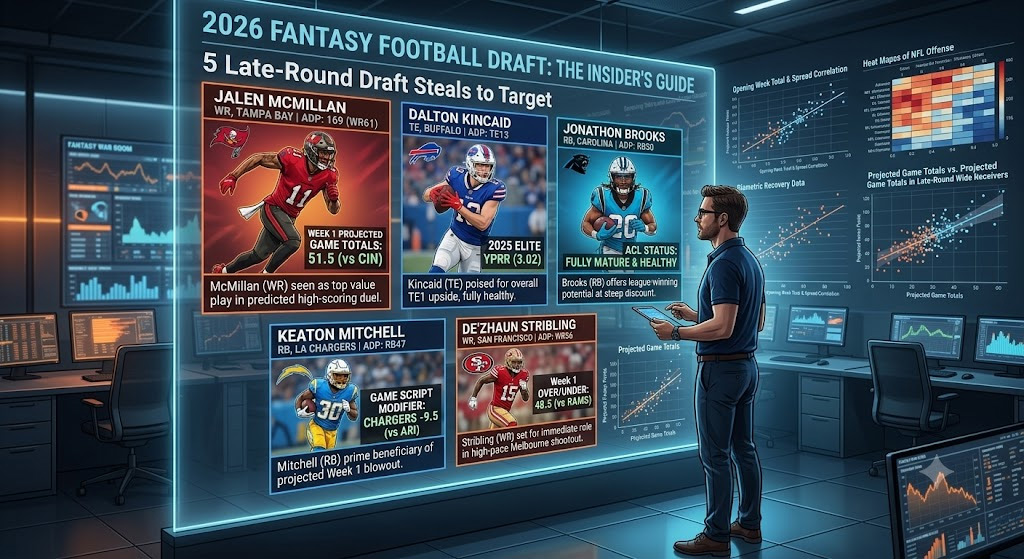
Tampa Bay’s third-year wideout represents a glaring market disconnect. McMillan currently languishes at the bottom of draft boards near an overall pick of 169. Casual drafters see a recent minor knee tweak and assume he is nothing more than rotational depth. The presence of veteran Chris Godwin and rising star Emeka Egbuka artificially clouds the target distribution in the minds of the public. Look closer, however, and you realize franchise legend Mike Evans vacated the primary X-receiver role. Emeka Egbuka operates almost exclusively from the slot and Z positions. Godwin relies entirely on manufactured middle-of-the-field touches at this stage in his career. That specific schematic vacuum leaves the perimeter completely exposed for McMillan.
A severe neck injury destroyed his sophomore campaign in 2025. Vestibulo-ocular tracking issues usually sink a receiver because they disrupt the neurological ability to track a ball in mid-air. McMillan defied the odds by returning in Week 15—instantly absorbing a brutal hit with zero structural damage. He torched Miami for 114 yards on seven catches just two weeks later. Week 1 sets up a cinematic return against the Bengals. Defensive coordinators in Cincinnati love their two-high safety shells. That specific alignment practically begs opponents to win isolated boundary matchups. Vegas set the over/under for this contest at an explosive 51.5 points. The Bengals only hold a narrow 3.5-point edge at home, meaning a blowout is highly unlikely. Tampa Bay will have to throw deep into the fourth quarter just to survive. You are essentially stealing a starting boundary receiver in a premier shootout.
De’Zhaun Stribling: The Shanahan Attrition Clause
San Francisco’s offensive geometry demands extreme kinetic efficiency. Severe injury attrition has completely decimated their depth chart heading into 2026. Ricky Pearsall is gone with a torn PCL. Christian Kirk is dragging a bad calf through training camp. Deebo Samuel remains the focal point, but Kyle Shanahan desperately requires a secondary field-stretcher to make his 21-personnel horizontal zone concepts actually work. De’Zhaun Stribling perfectly fits this exact prototype. The kid posted a ridiculous 2.44 yards per route run (YPRR) in college. He violently forces missed tackles in open space—an absolute necessity in a scheme built entirely on yards after the catch.
San Francisco must survive a bizarre Thursday night excursion to Melbourne just to kick off their season. A grueling trans-Pacific flight usually destroys defensive coordination. Player sleep cycles turn to garbage, while traditional practice periods completely vanish. Oddsmakers installed the Rams as 3.5-point favorites alongside a juicy 48.5 over/under. My read? The math guarantees an absolute track meet on offense. Rams defenders will inevitably stack the box to counter the wide-zone rushing attack. Stribling will find himself isolated on the perimeter with 4.36 speed. One broken tackle on a deep dig route equals a seventy-yard score. His WR50 price tag is a legitimate market glitch.
Dalton Kincaid: Bypassing the Tight End Wasteland
Middle-round tight ends are a mathematically losing bet. To secure elite volume, managers usually burn a top-three draft pick. Buffalo’s starting tight end currently shatters that exact rule by slipping deep into the 11th round. Public perception of the kid completely tanked after a miserable 2025 campaign. A nasty collarbone fracture wrecked his early momentum. He later pushed through a torn PCL, ultimately logging a worthless 38 percent snap share for fantasy managers. The catch? Kincaid skipped knee surgery entirely. He spent the entire offseason rebuilding his posterior chain to eliminate the biomechanical compensations that caused his secondary hamstring injuries. Buffalo camp reports indicate he looks like a completely different athlete.
We need to examine his underlying efficiency. Kincaid logged a position-leading 3.02 YPRR when actually on the field last year. The front office added DJ Moore to terrify opposing cornerbacks on the boundary. This localized gravity empties the middle of the field for Josh Allen’s favorite zone-beater. Week 1 sends Buffalo to Houston in a tight 1.5-point spread. The 40.5 total implies a grinder, but the close margin forces aggressive play-calling. Houston’s relentless pass rush will force Allen into quick-game progressions to avoid sacks. Kincaid operates as the primary read on those precise concepts. Do yourself a favor; ignore those low-ceiling handcuff runners in the late rounds. Grab a tight end possessing a legitimate 100-catch ceiling instead.
Keaton Mitchell: Garbage Time is a Mathematical Certainty
Late-round running backs usually require an ambulance to hit your starting lineup. Keaton Mitchell offers standalone value thanks to a massive geographic coaching shift. Mike McDaniel took over the Chargers’ offense and brought his wide-zone track meet with him. Omarion Hampton serves as the bruising, between-the-tackles hammer. Mitchell acts as the perimeter lightning rod. McDaniel famously used De’Von Achane in this exact role to break fantasy leagues a few years ago. Mitchell boasts a career average north of five yards per carry. Defensive linemen simply cannot adjust to his 4.3 speed after getting bludgeoned by Hampton for three quarters.
The opening week script against Arizona is a goldmine. Los Angeles opens as a massive 9.5-point favorite. Huge point spreads guarantee predictable fourth-quarter behavior. Coaches heavily protect their expensive assets when up by two scores. Hampton will take a seat on the bench. Mitchell will inhale double-digit touches against an exhausted Cardinals front. A single 40-yard run pays off his ADP instantly.
Jonathon Brooks: The Patience Payout
Cowards avoid running backs with two ACL tears. The market overcorrection on Jonathon Brooks is simply too drastic to ignore. The former premium prospect out of Texas currently lingers in the eighth round of most drafts. We all know the medical rap sheet. A collegiate knee injury derailed his initial momentum; two games into his rookie year, the structural graft failed completely. Carolina’s front office essentially locked him away for the entirety of 2025 to prevent another disaster. Modern sports medicine dictates that an ACL graft requires two full years to achieve biological symmetry. Brooks finally possesses his structural integrity.
The Carolina depth chart is a total ghost town. Chuba Hubbard is a low-ceiling placeholder. The front office completely ignored the position in free agency, leaving a massive runway for their former premium investment. Week 1 features a clash with the Bears where the Panthers will desperately need functional offense. Brooks might not see twenty carries in September. By October, his elite contact balance and vision will relegate Hubbard to the bench. You are essentially buying an RB1 at a flex price tag.




AI Checker: Verify Your Content Authenticity Instantly

American Airlines To Bring Back Seatback Screens, More Premium Seating

Gordon Murray’s S1 V12 Manual Supercar Is Basically A Modern McLaren F1

Ford Mustang Dark Horse SC Convertible: 795 Horsepower Never Sounded So Good!

McLaren Finished Its Founder’s Unfinished Supercar Dream, The McL 6GT
American Airlines To Bring Back Seatback Screens, More Premium Seating

The Manual 911 Carrera S Is Back For 2027, And It’s Exactly What You Hoped For
Ford Mustang Dark Horse SC Convertible: 795 Horsepower Never Sounded So Good!
McLaren Finished Its Founder’s Unfinished Supercar Dream, The McL 6GT
Gordon Murray’s S1 V12 Manual Supercar Is Basically A Modern McLaren F1

Watch The Fast And Furious Trailer For ‘Hobbs & Shaw’

A Dance-Off For The Ages Broke Out At Monday Night’s 76ers Game

Netflix Drops ‘Black Mirror: Bandersnatch’ Trailer Ahead Of Release Tomorrow

Former NASA Engineer Gets Revenge On Package Thief With Glitter Bomb

Recent Comments