
Technology
Are AI Earbuds Worth It In 2026? An Honest Week-Long Review

On a subway platform after a meeting-heavy morning, I opened my phone and found a rough AI transcript waiting before I reached the office elevator. A few names needed cleanup, but the action items were there. That was enough to make me wonder whether AI earbuds are genuinely useful in daily life or mostly a spec-sheet feature.
Over the next seven days, I used them across meetings, commutes, workouts, and evening listening. This review covers what held up in real life: AI transcription, adaptive ANC, voice control, battery tradeoffs, and which routines make the premium easier to justify.
How I Tested This Week
Test Setup
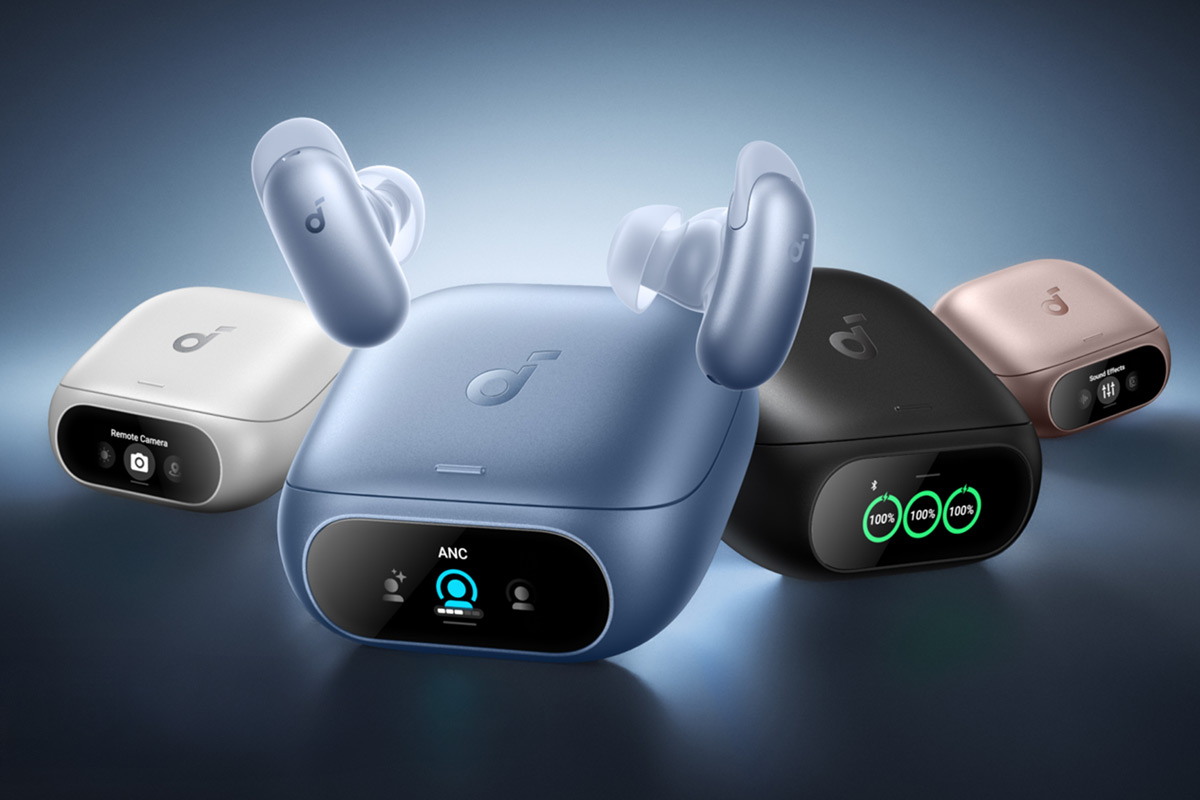
I tested the soundcore Liberty 5 Pro Max ($229.99) in real daily use instead of lab conditions. The Sony WF-1000XM5 and AirPods Pro 2 served as premium benchmarks in the $200–$280 range. The key question is whether AI features stay useful after the first week.
Over seven days of meetings, commutes, workouts, and listening sessions, I tracked transcription, adaptive ANC, voice control, battery life, and long-term usage habits. The Sony and Apple models provided a baseline for ANC, ecosystem fit, and premium performance.
Fact-Checking Approach
Product facts were checked against current soundcore product pages. For measured ANC depth or call quality, independent labs such as RTINGS and SoundGuys are better sources than marketing specs alone. My experiential numbers, including transcription spot-checks and voice success rates, come from my week of notes.
AI Transcription: Useful or Overhyped?
Is It Useful in Real Meetings?
The AI Note Taker on the soundcore Liberty 5 Pro Max works best as a review aid for in-person meetings, not as a formal note-taking replacement. In my test week, it delivered practical recaps across five quiet meetings. Sony WF-1000XM5 and Apple AirPods Pro 2 do not include this kind of built-in meeting recorder, though they can work with separate meeting apps.
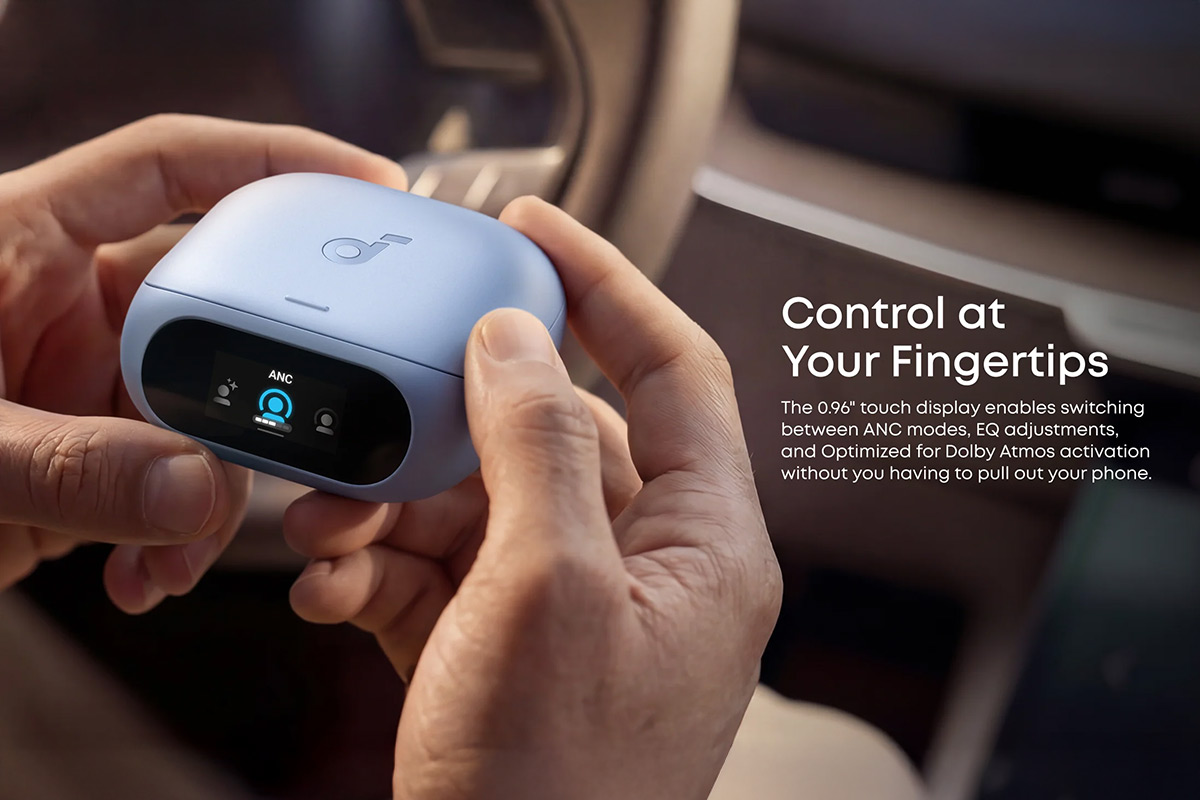
Recording runs through the Liberty 5 Pro Max smart charging case, not the earbuds themselves. Set it on the table, tap record on the 1.78 inch AMOLED screen, and review the transcript and summary in the soundcore app afterward.
Accuracy and Use Cases
In quiet rooms, my spot-checks landed around 85 to 90 percent accuracy on names and action items. Accuracy dropped with overlapping speech, jargon, and echoey rooms. The summary was usually more useful than the full transcript because it turned a messy conversation into a short list of decisions and follow-ups. For a client meeting or stand-up, that was enough. For legal, medical, or heavily technical conversations, I would treat it as a draft.
Cost and Subscription Limits
Cost needs a careful read. Basic recording is included, AI transcription and summaries require a paid plan after the included quota, and the free Starter Plan includes 120 minutes of AI transcription per month for 24 months. That is not the same as AI transcription being free forever. Light meeting weeks fit comfortably inside the Starter Plan; heavy weeks need a quick math check.

Adaptive ANC: Does It Actually Adapt?
Does It Adapt During a Commute?
Yes, especially when noise stays loud. Adaptive ANC struggles when your environment shifts every few seconds.
On subway runs, the Liberty 5 Pro Max tuned noise control as I moved from quiet hallways to platform noise and train rumble, usually after two or three seconds. It was not instant, but steady enough that I stopped opening the app for manual modes. Low rumble softened first, then speech and sharper platform noise.
Product Context
Liberty 5 Pro and Liberty 5 Pro Max run Adaptive ANC 4.0. Sony WF-1000XM5 and AirPods Pro 2 use their own adaptive noise control systems. Sony sets a h3 benchmark for noise cancellation, and Apple’s audio features integrate deeply with iPhones. Soundcore claims its ANC doubles the performance of the older Liberty 4 Pro, yet this is only an official statement without independent lab verification.
Where It Fits
Adaptive ANC works best in consistently noisy places like public transport, offices and cafes. It reacts slowly to sudden scene changes, where manual transparency mode is more responsive. If you prioritize sound isolation, compare different noise cancelling earbuds first before weighing extra AI features.

AI Voice Control: Convenience or Frustration?
Is It Better Than Touch Controls?
It depends on the setting. In a quiet home office, Liberty 5 Pro Max voice commands for playback, volume, and calls succeeded more than 90 percent of the time. On the street, I had to speak more deliberately. In the subway, success fell to about 60 percent, so I used touch controls instead.
Soundcore supports offline on-earbud commands in English, German, Japanese, and Chinese without a phone or internet. It also claims about three times faster response on simple commands like skipping tracks, but that is a brand lab figure, not a direct comparison with Siri or Alexa. Apple still goes deeper through Siri for phone tasks, while Sony leans on assistant integrations in its app.
Voice vs Touch in Daily Use
There is also a social layer people forget to test. Saying “volume up” on a packed train feels more noticeable than a subtle tap. Voice control fit naturally when my hands were full at home, when I was cooking, or when I was walking in moderate street noise. Touch controls stayed easier in public.

Real-World Limitations You Won’t Read in the Specs
Specs rarely tell you which features become habits after day seven. These were the patterns that showed up repeatedly once the newness faded.
Battery and Charging Rhythm
Battery life is the main daily compromise. With ANC enabled, the soundcore Liberty 5 Pro Max lasts 6.5 hours per charge and 28 hours total with the case. When all smart features run, battery drops to around 4 hours per bud and 17 hours overall. I charged nightly on busy days. Disabling voice control extended usage to nearly one and a half days.
Sony WF-1000XM5 offers 8 hours of playtime with ANC on, while AirPods Pro 2 hits 6 hours. These official figures are for reference only. Actual runtime varies with volume, audio codecs and call usage.
Recording Setup and Consent
The recording workflow had its own friction. Because capture happens through the case microphone, the case needs to be nearby and positioned sensibly. That worked well on a desk or conference table, but it was less natural in a hallway conversation that started before I remembered to record. The feature felt better for planned meetings than spontaneous chats. You also need consent and local recording rules in mind before using cloud transcription at work.
Workouts and Stability
The gym exposed different priorities. IP55 helps with sweat and dust, but fit, physical controls, and accidental touches mattered more than any AI feature during faster workouts. Environment sensing also felt a step behind what I noticed during commutes once movement and wind picked up. I counted three short dropouts across the week: two during device switching and one while a recording workflow was active.
If workouts are your main use case, waterproof earbuds with sport-first controls may deserve more attention than AI-heavy models.
Feature Habits by Day Seven
By day seven, adaptive ANC had become the most automatic habit because it worked in the background. Transcription was useful only for specific in-room meetings where I had time to set up the case and review the summary. Voice control was the most situational: convenient at home or while cooking, less appealing on crowded trains.
Who Should Pay More for AI Earbuds
AI features are meaningful when they solve a repeated weekly problem. A $30 to $50 premium makes the most sense when your routine already includes noisy commutes, in-room meeting recall, or hands-busy control. In 2026, the category feels useful but still selective. The better question is whether the tools match your week.
Fit Scores by User Type
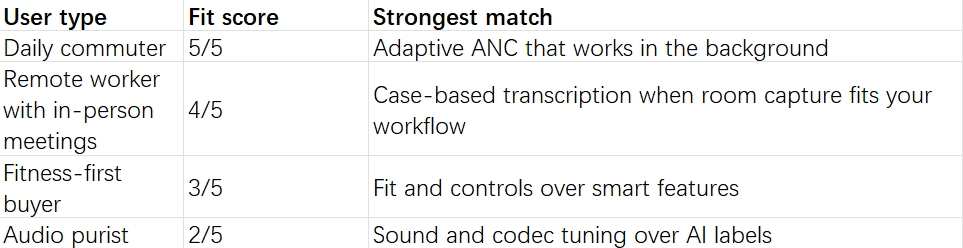
Daily commuters got the clearest win from adaptive ANC because the feature runs in the background. Remote and hybrid workers with in-person meetings can benefit from case-based transcription if room capture matches how they work. Fitness-first buyers should prioritize fit and controls. Audio-focused buyers should audition sound and codec support before paying for AI labels they may never open.
A Quick Filter Before the Premium
Use this quick filter before paying extra: Can you start the feature when you need it? Do you understand the subscription limits? Does the product fit your phone ecosystem? If recording is part of your workflow, get participant consent and check local recording laws. Sony is a useful reference for longer ANC listening sessions, Apple remains a natural fit for iPhone-first users, the Liberty 5 Pro Max is most distinctive for in-room meeting capture.
Conclusion
After seven days of real use, the premium made the clearest sense when AI removed a friction point I kept running into. The category is promising, but the right starting point is still a specific weekly problem: in-room meeting recall, noisy commuting, or hands-busy control.
If your week includes in-room meetings and loud commutes, the soundcore Liberty 5 Pro Max is the model I would check first. Review its specs and membership terms on the official product page to see if it fits your routine.
FAQ
Are AI earbuds better than regular earbuds?
They are only worthwhile if you use their smart features regularly. AI functions boost convenience but do not improve fit, comfort or sound. Regular ANC earbuds are a better choice for casual music, podcasts and short calls.
Do AI transcription earbuds replace meeting apps?
Not fully. They can help with face-to-face conversations and quick in-room notes, but tools like Otter.ai, Zoom summaries, Google Meet, or Microsoft Teams may still fit better for team sharing, speaker labels, archives, admin control, and online calls the case mic cannot record.
Is adaptive ANC worth paying extra for?
Yes, if you commute or work in changing noise. Adaptive ANC reduces manual switching and makes earbuds feel less fussy during real life. If you mostly listen at home or in one quiet office, fixed ANC or manual transparency mode is usually enough.
Are AI earbuds good for workouts?
They can work for workouts, but AI is not the main reason to buy them. For exercise, prioritize fit, water resistance, sweat-friendly controls, and stability.
How much extra should you pay for AI earbuds?
A $30 to $50 premium can be reasonable if you will use transcription, adaptive ANC, or voice control every week. Paying much more makes sense only if the earbuds also win on the basics: comfort, battery, ANC, calls, sound, and ecosystem fit.



A Smarter Chicago, Illinois Food Weekend: Pair Neighborhoods, Appetite, and Budget

FuelFest Brings Car Culture Spectacle To New Jersey This Saturday!

The Mercedes-AMG CLE 646 Is A 637-Horsepower Track Weapon

Aston Martin’s First Road Bike Is Here, And Only 300 People Will Own One

New Street Fighter Trailer Is Here, And It’s Everything We Wanted
Aston Martin’s First Road Bike Is Here, And Only 300 People Will Own One

TAG Heuer’s Limited-Edition Monza Is A Tribute To Niki Lauda’s Title Run
New Street Fighter Trailer Is Here, And It’s Everything We Wanted

HUSH Pro Clipper: The Cordless Upgrade Your Head-Shaving Routine Needs
FuelFest Brings Car Culture Spectacle To New Jersey This Saturday!

Watch The Fast And Furious Trailer For ‘Hobbs & Shaw’

A Dance-Off For The Ages Broke Out At Monday Night’s 76ers Game

Netflix Drops ‘Black Mirror: Bandersnatch’ Trailer Ahead Of Release Tomorrow

Former NASA Engineer Gets Revenge On Package Thief With Glitter Bomb

Recent Comments