
Cars
Ferrari Luce EV Looks Like A Nissan Leaf Had A Baby With An Apple Mouse

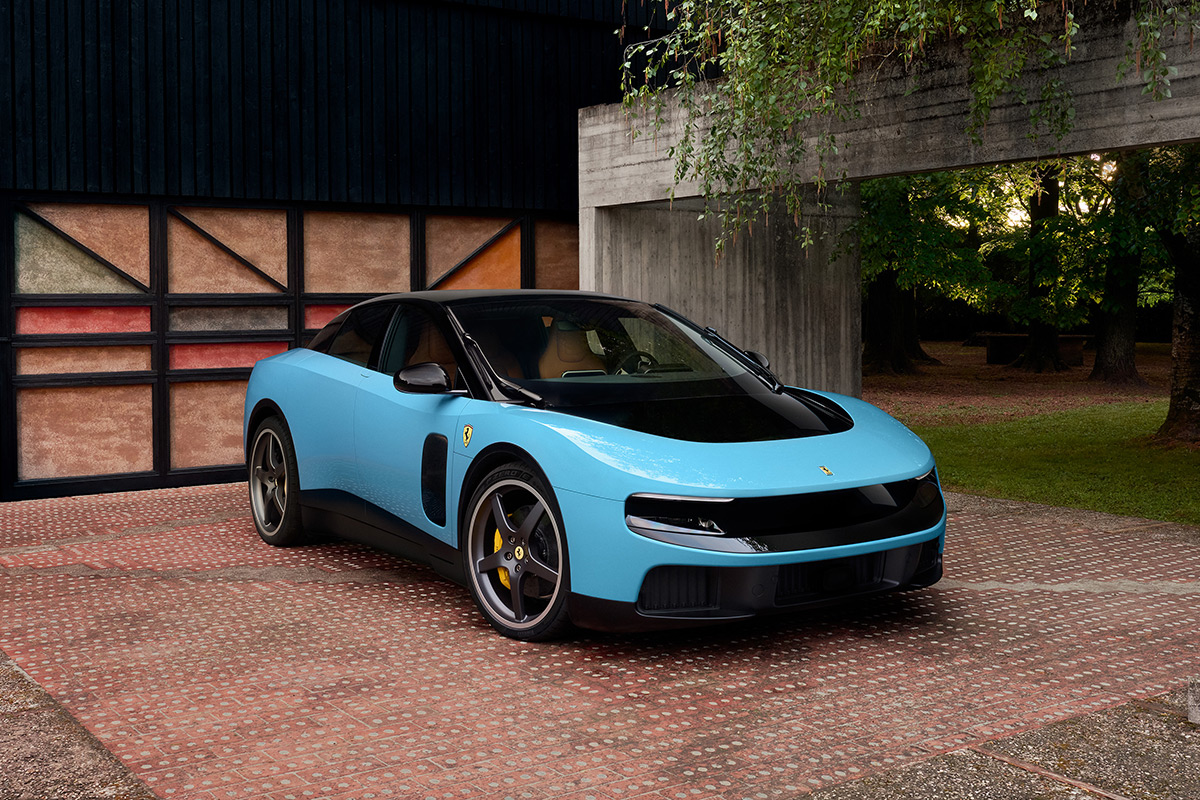
The Ferrari Luce just landed with a thud. Here’s everything you need to know about the most divisive Ferrari ever made.
Ferrari, the brand that has given us beauties like the 458 Italia, the F40, the LaFerrari, cars that make grown men stop in their tracks, just unveiled what was supposed to be its boldest, most revolutionary automobile in decades, as the brand’s first EV. And instead, it looks like a Nissan Leaf got busy with an Apple mouse. Talk about a disappointment!
This is the Ferrari Luce. Even the name feels like they’re trying too hard to convince you that this thing is something special. Luce means “light” in Italian, and according to Ferrari’s PR and marketing team, it “lights the way to the future.” But for many of us who grew up worshipping the Prancing Horse, it’s the kind of light you see at the end of a tunnel when the brand you love has gone off a cliff.
What Is The Ferrari Luce?
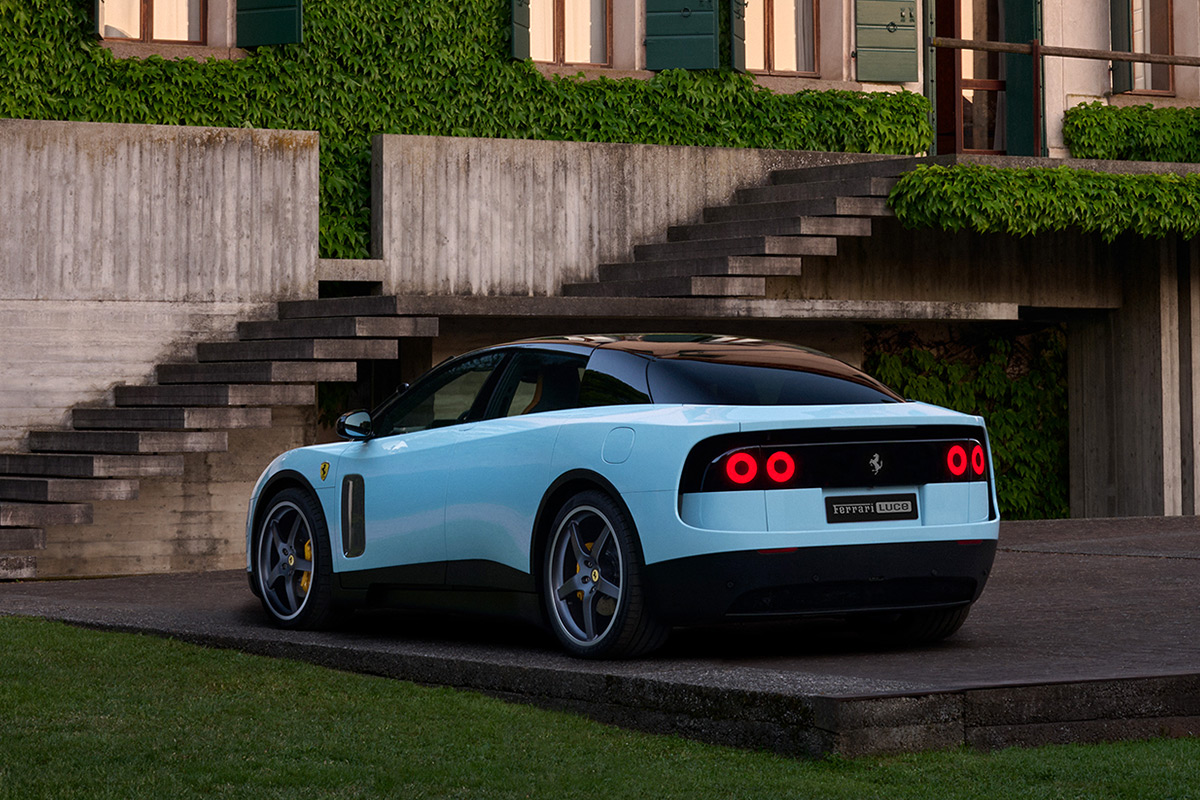
Unveiled on the anniversary of Ferrari’s first-ever racing victory in 1947, the Luce is Ferrari’s first fully electric production car. It’s a four-door, five-seat luxury sports car built on a bespoke all-electric platform with four electric motors (one per wheel), a 122-kWh battery, and a range of around 300 miles. It does 0-62 mph in 2.5 seconds, hits a top speed of over 193 mph, and produces a combined maximum output of 1,035 horsepower.
On paper, those numbers are genuinely impressive. In person (or at least in the photos that broke the internet), the Luce looks like what happens when you ask an AI to design a luxury sedan for someone who has never seen a Ferrari before.
The design was handled not by Ferrari’s in-house studio, but rather by LoveFrom, the design collective led by Sir Jony Ive and Marc Newson, the same people responsible for the iPhone and a great deal of Apple’s iconic product design.
Ferrari’s President John Elkann defended the unusual choice, saying: “Such a leap forward in product innovation could only have been achieved through process innovation; this is why we chose to embark on new collaborations, such as the one with LoveFrom for the design.”
We get it. Bold move. But while Apple’s design language works on a phone, on a Ferrari it looks soft, sterile, and completely devoid of the aggression and passion the brand is known for.
The Design: A Glasstop Vacuum Cleaner
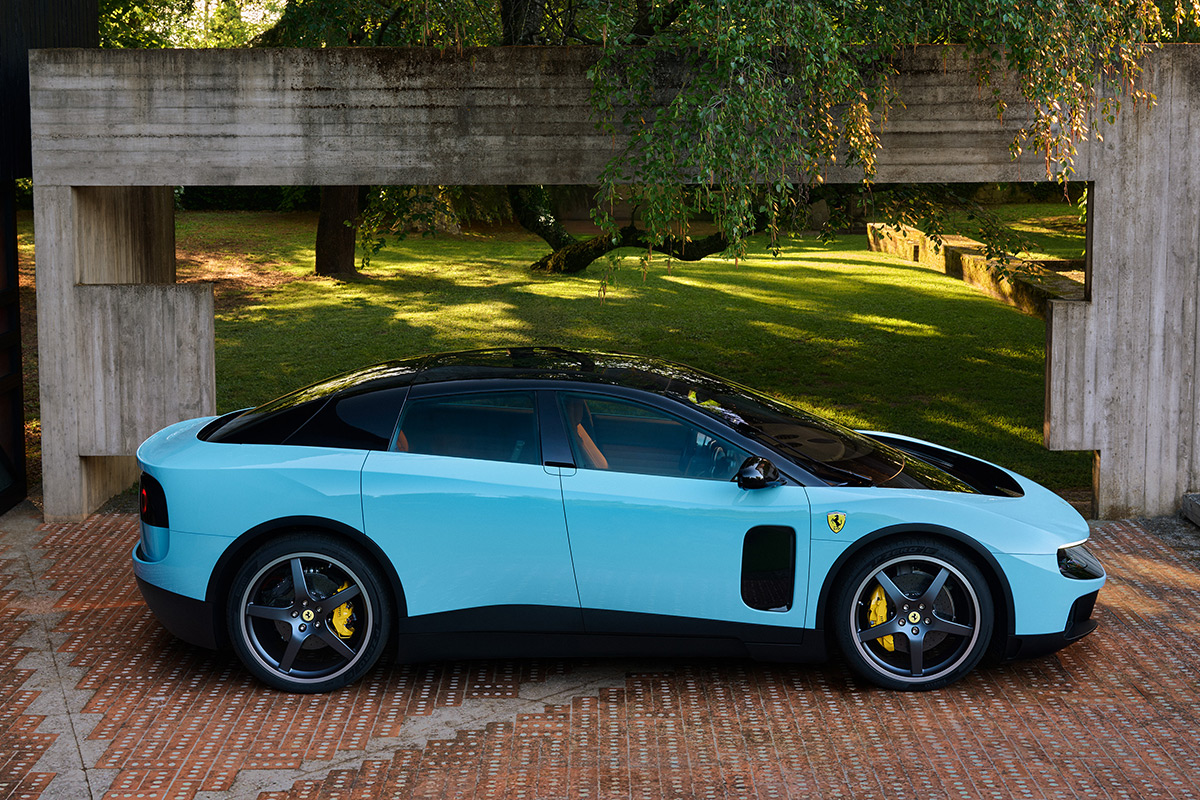
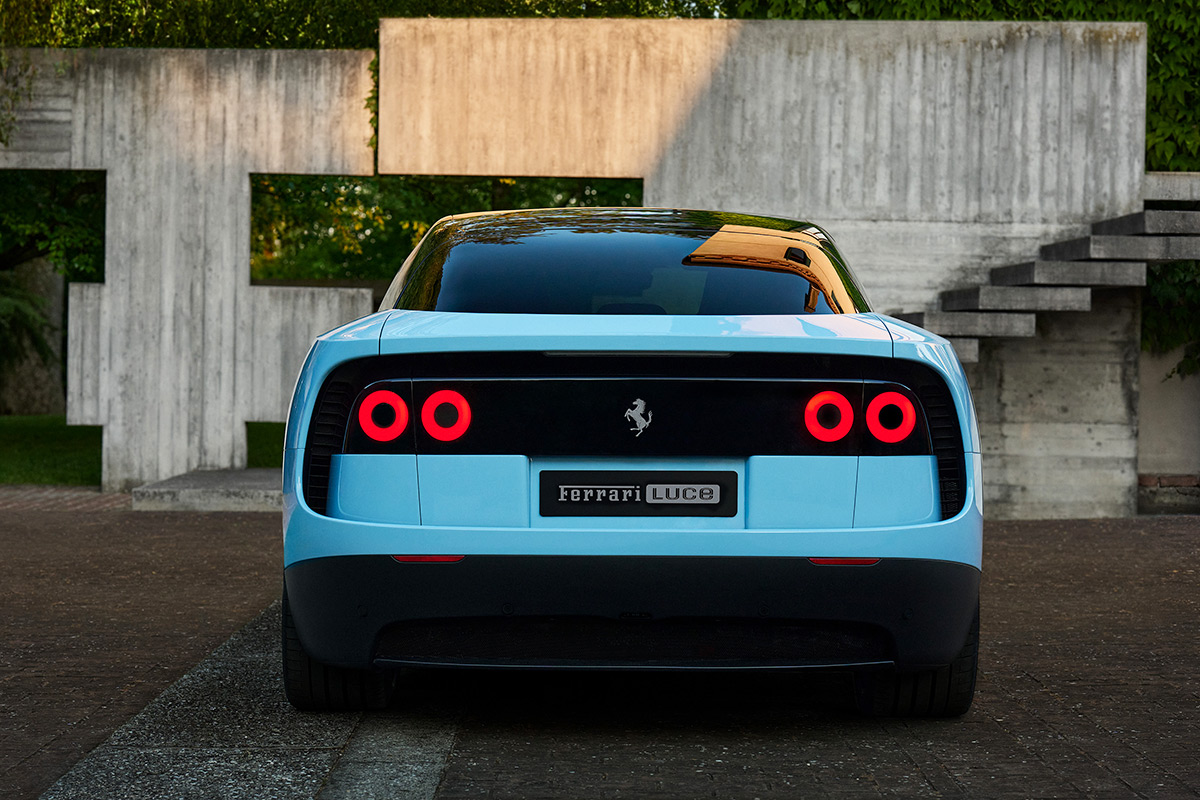
Ferrari describes the defining feature of the Luce as the “unprecedented purity of the glass house,” a shell-like, nearly uninterrupted greenhouse that wraps around the entire car. The front and rear aerodynamic wings “float” around this central glass cell. The lights are transparent and “gently recede when switched off.”
Look, we can appreciate what they were going for. Clean. Pure. Futuristic. But this doesn’t look ANYTHING like a Ferrari. Commenters on the Internet have been having a field day with it, calling it an Apple mouse on wheels. Others compared it to a vacuum cleaner. One went viral for pointing out the resemblance to a Nissan Leaf, and they’re honestly not wrong.
“Oh boy, how ugly she is,” said Luc Poirier, a Montreal-based owner of 40 Ferraris. “How (do you) justify a 400,000 to 500,000 price for this? Unbelievable.” That’s not some random guy on Reddit, that’s a man who owns forty Ferraris. When collectors with that kind of brand affinity are shaking their heads, something has gone seriously wrong.
The Man Who Saved Ferrari Is Furious
But the harshest reaction didn’t come from online keyboard warriors or jealous rivals. It came from Luca di Montezemolo, the man widely credited with turning Ferrari from a struggling automaker into the most revered sports car brand on earth. Di Montezemolo served as Ferrari’s president from 1991 to 2014, overseeing 19 Formula 1 World Championships and the creation of some of the greatest Ferraris ever built.
When cameras caught him outside the unveiling in Rome, he looked gutted. “If I say what I think, I’d cause harm to Ferrari,” he said in Italian, shaking his head. “We’re risking the destruction of a myth.” He went even further, suggesting Ferrari should remove the Prancing Horse logo from the car entirely, adding: “I am truly sorry. I hope they remove the Prancing Horse [logo], at least from that car.” And in a pointed jab at the design, he said: “This is certainly one car the Chinese will not copy from us.”
Italian Deputy Prime Minister and Transport Minister Matteo Salvini also piled on, writing on X: “Electric, outrageously expensive (550 thousand euros!) and, from an aesthetic point of view, it speaks for itself… It looks like anything but a car from the Prancing Horse. And this is supposed to be ‘innovation’? Who knows what [Ferrari founder] Enzo Ferrari would say…”
When the country’s own transport minister is dunking on a national automotive icon, the launch has not gone well.
The Price: Who Is This Even For?
Let’s talk about the price. $640,000. Six hundred and forty thousand American dollars. For context, that’s more than twice the price of a brand-new Ferrari Roma. It’s even more than a Lamborghini Revuelto. You could buy a very nice home in a very nice neighborhood for that kind of money.
The launch affected Ferrari’s stock price, which dropped sharply after the Luce was revealed. At its worst, Ferrari’s Milan-listed stock fell 8% on Tuesday after the unveiling. Investors know something the marketing team doesn’t want to acknowledge: a lot of the people who buy Ferraris are buying Ferrari – the sound, the rage, the pure combustion-engine theater. Electric motors, however fast, can’t replicate that.
Ferrari CEO Benedetto Vigna tried to defend the price on Thursday, saying the cost was fair for the level of innovation involved. He told CNBC: “You have to see Luce to understand that it has nothing to do with Chinese EVs or those by other brands.” He also pushed back against critics on LinkedIn, writing: “We need to bear in mind that true innovation does not look for immediate consensus, nor does it stem from the ordinary.”
Selling an EV is a hard enough prospect. But selling one that looks nothing like a Ferrari yet carries a supercar price tag, well that’s going to be a mighty tall order. It’s like they didn’t learn anything from any of the other brands who went “all-in” on EVs over the past 5-6 years and then had to change course (and take multi-billion-dollar write-offs) when they discovered that the demand just wasn’t there.
Okay, The Specs Are Actually Wild
We’ll be fair: underneath the bubble-car body, the engineering story is pretty extraordinary. Some highlights for the spec nerds:
Performance:
- 0–62 mph in 2.5 seconds
- 0–124 mph in 6.8 seconds
- Top speed of 193 mph
- Maximum output of 1,035 hp
Powertrain: The four electric motors are derived from the Ferrari F80 supercar and developed in-house at Maranello. The rear motors spin up to 25,500 rpm; the fronts hit 30,000 rpm. In Launch Control mode, the system draws on an additional 40 kW boost, bringing peak output to 765 kW. The battery is a 122 kWh, 800V unit with support for up to 350 kW DC fast charging, capable of adding 70 kWh in just 20 minutes.
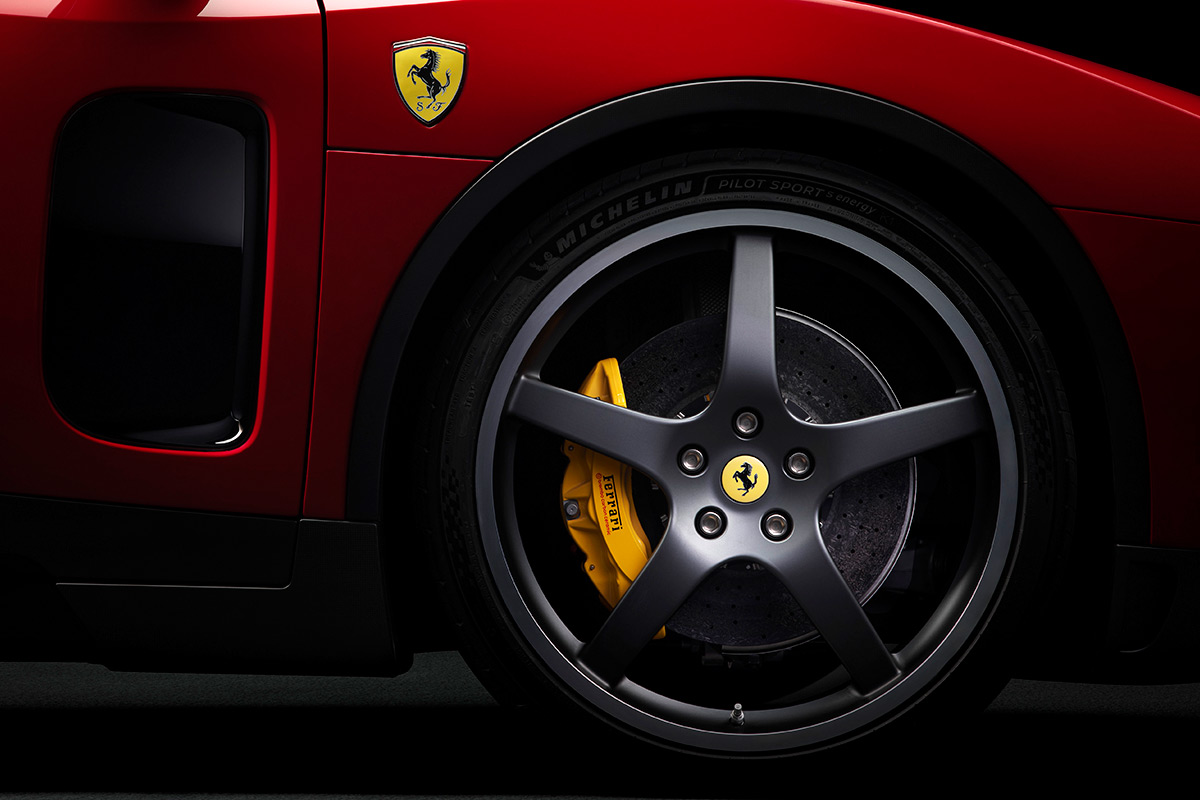
Torque Vectoring: Each wheel gets its own motor, its own steering actuator, and its own active suspension actuator, meaning the car can independently control acceleration, steering angle, and vertical movement at each corner simultaneously. This is genuinely mind-bending engineering and Ferrari claims handling equivalent to a car weighing 900 lbs less than the Luce’s 4,982 lb curb weight.
The Sound: Ferrari spent 5 years and 25,000 miles of track testing to figure out how to make an electric car sound like a Ferrari. Their solution: a precision accelerometer mounted on the rear axle captures the vibrations of the rotating components in real time and amplifies them through the speaker system — similar in principle to the way an electric guitar pickup works. The result is an authentic mechanical sound that evolves with speed and throttle input, rather than a synthesized noise pumped through speakers. In Performance mode, it’s audible outside the car. In Range mode, you get near-silence. It’s a genuinely clever solution to one of the fundamental problems with electric sports cars.
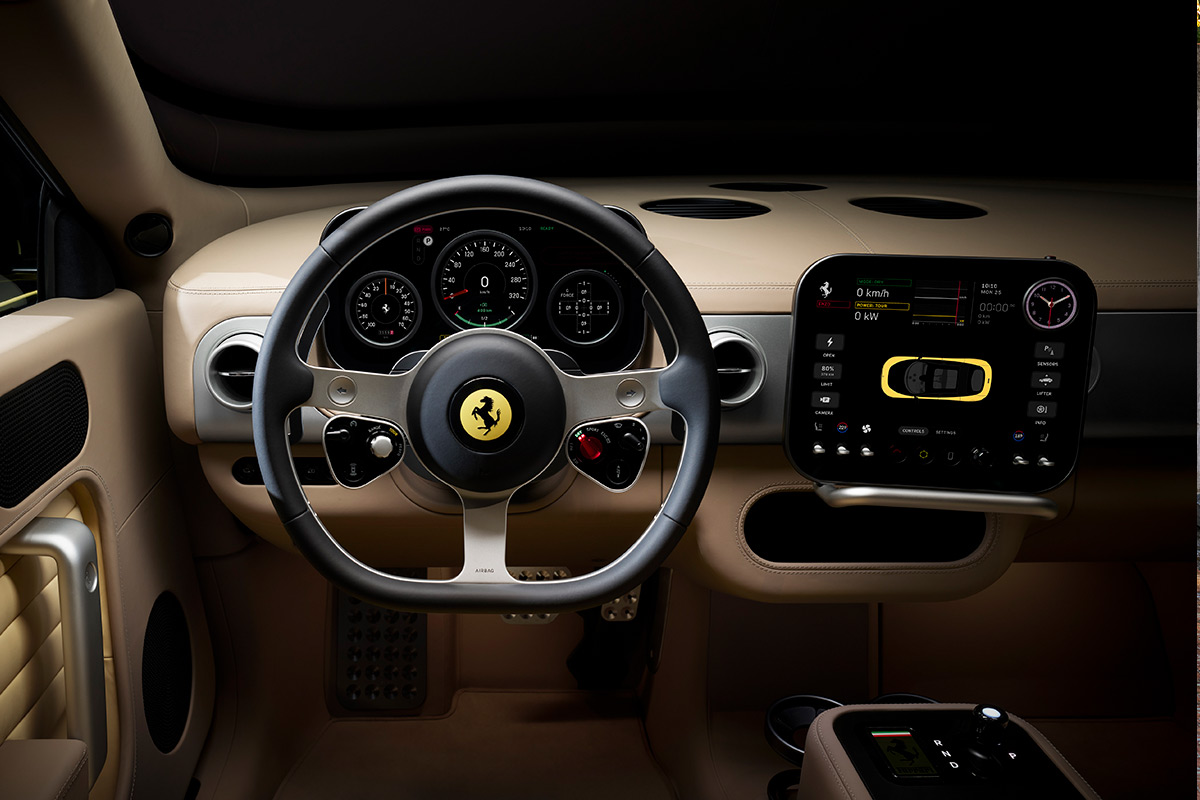
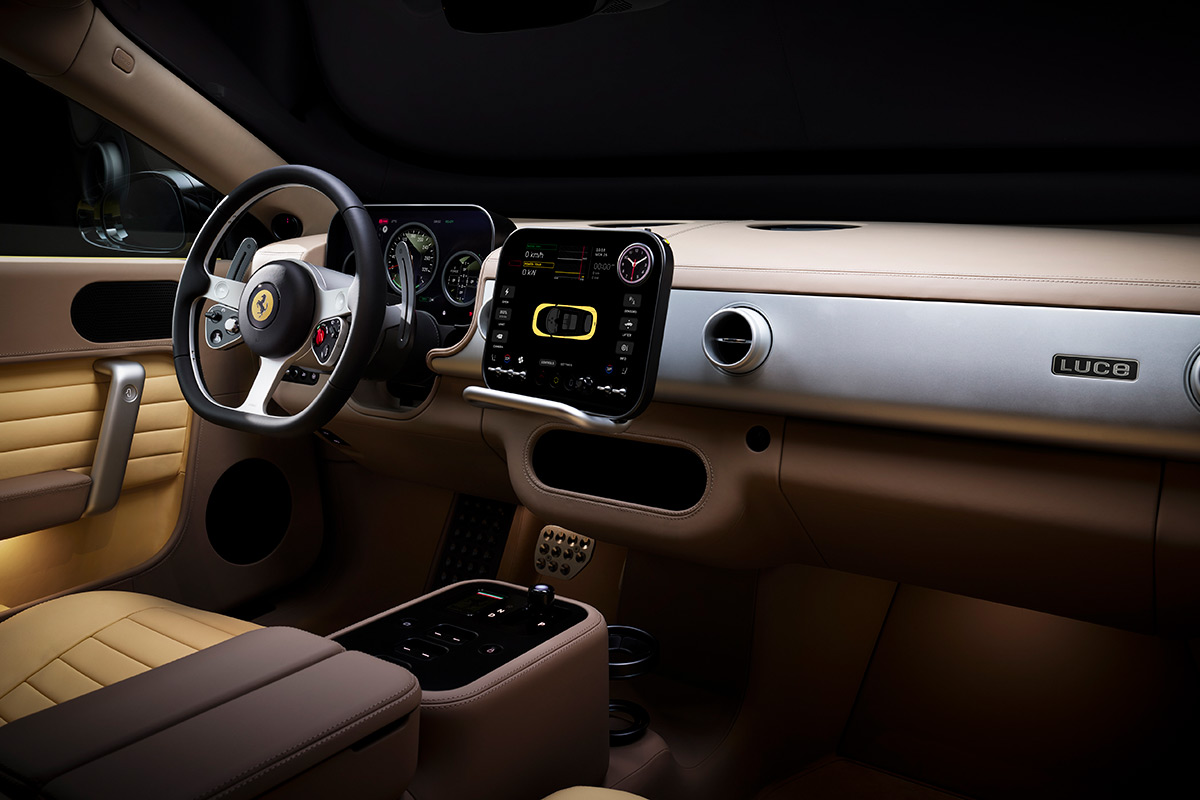
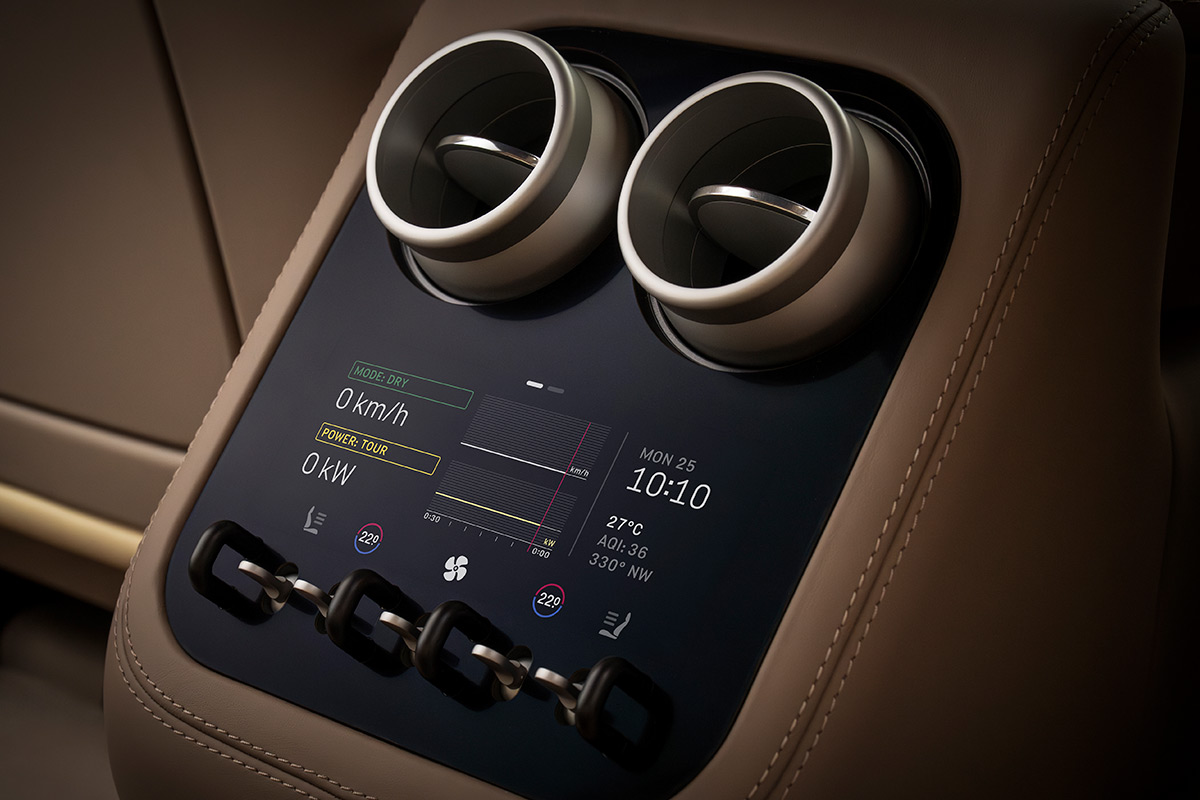
Interior: The cockpit is one area where the Jony Ive influence actually works reasonably well. The binnacle moves with the steering wheel. The physical key is made from Corning Gorilla Glass and features an E Ink display, a world first in automotive. Samsung Display developed four custom OLED screens exclusively for the Luce. The steering wheel is machined from 100% recycled aluminum. There are 21 speakers running through 3,000W of amplification across 24 channels. Five seats, genuinely usable rear space, and a flat floor thanks to the battery being integrated into the floor structure.
“We are convinced that a company demonstrates its leadership when it has the courage to dare and to take on the challenge of new technologies. Ferrari Luce was born precisely from this challenge, offering our unprecedented vision of electrification,” said Benedetto Vigna, CEO of Ferrari.
Is This the End of Ferrari As We Know It?
Ferrari insists that the Luce doesn’t replace anything. It’s expanding the range, not replacing combustion engines. They’ve described their approach as “technological neutrality, meaning ICE, hybrid, and pure electric will all coexist.
“With Ferrari Luce, we are once again redefining the limits of what is possible. Today, we are not simply unveiling a new car, we are inaugurating a chapter that turns our vision into reality, strengthening Ferrari’s tradition of anticipating and shaping the future,” said John Elkann, Ferrari President.
Fine. We’ll take that at face value. But here’s our concern. Once you start making electric four-door family sedans, no matter how fast they are, you start chipping away at the mythology. Ferrari’s power as a brand comes from scarcity and desire. Ferrari sells only about 14,000 cars a year, a strategy that creates FOMO and a rabid fan obsession among wealthy car aficionados. The moment the Prancing Horse becomes just another badge on a luxury EV, something irreplaceable is gone.
Michael Field, chief equity strategist at Morningstar, put it plainly: “Ultimately many fans are disappointed that Ferrari is embracing the EV concept, believing it dilutes the supercar brand, which has modelled itself around classic design and raw, combustion-engine power.”
The Bottom Line
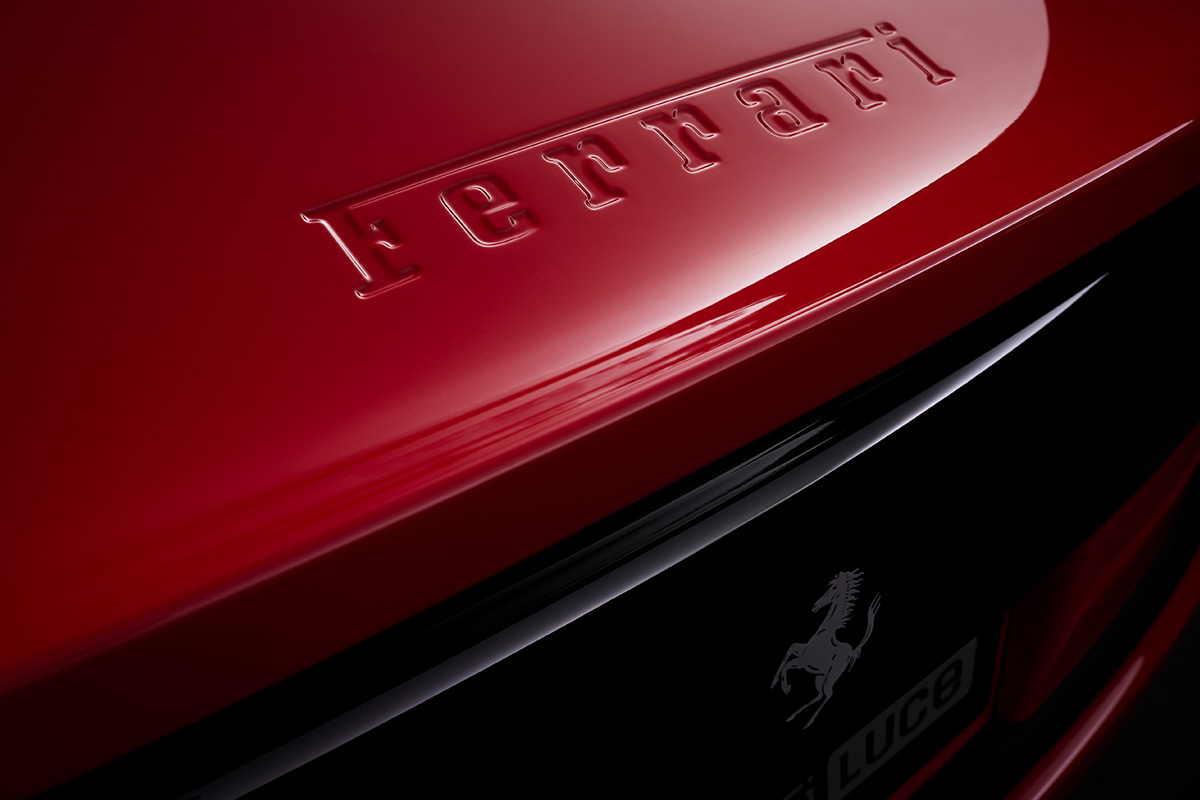
Yes, the Ferrari Luce is, in a purely technical sense, an extraordinary piece of engineering. The numbers are real, the patents (over 60 of them) are real, and the innovation happening under that glass shell is genuinely impressive.
But a Ferrari has never been just about the numbers. It has been about the way it makes you feel: the noise, the fury, the sense that you’re sitting in something completely unlike anything else on the planet. The Luce, at least from where we’re standing, doesn’t do that. It looks like a product. A very expensive, very well-engineered product. But a product nonetheless.
Ferrari says the Luce lights the way to the future. We say that future is going to take a lot of getting used to. Deliveries are scheduled to begin in the fourth quarter of 2026. Pricing starts at approximately $640,000. The Prancing Horse, for better or worse, is going electric.
What do you think of the Ferrari Luce? Are we being too harsh, or does this feel like a betrayal of everything Ferrari stands for? Let us know in the comments.



Is An $11.99 Apple Mystery Box Worth It? Inside GOATbox.gg’s MacHead

A Better Fit: How Esteem Apparel Helps Men Dress With More Confidence

Upgrade Tips For The 2013–2017 Subaru Crosstrek: Practical Accessories, Protection, and Value

Baywatch Is Back: FOX Drops The First Full Trailer For The Reboot

Is It Time To Replace Your Tires Before Winter?
Is It Time To Replace Your Tires Before Winter?
A Better Fit: How Esteem Apparel Helps Men Dress With More Confidence
Upgrade Tips For The 2013–2017 Subaru Crosstrek: Practical Accessories, Protection, and Value
Is An $11.99 Apple Mystery Box Worth It? Inside GOATbox.gg’s MacHead
Baywatch Is Back: FOX Drops The First Full Trailer For The Reboot

Watch The Fast And Furious Trailer For ‘Hobbs & Shaw’

A Dance-Off For The Ages Broke Out At Monday Night’s 76ers Game

Netflix Drops ‘Black Mirror: Bandersnatch’ Trailer Ahead Of Release Tomorrow

Former NASA Engineer Gets Revenge On Package Thief With Glitter Bomb

Recent Comments